
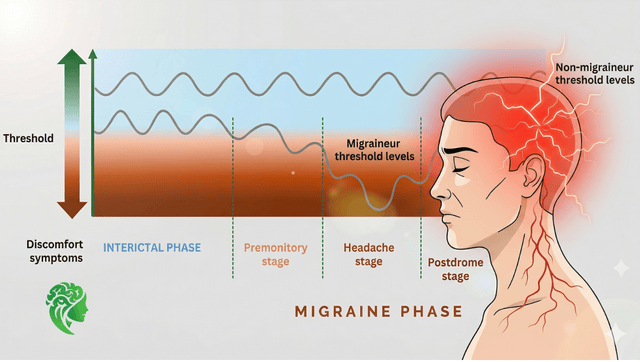
For many people, a migraine is often ignored as just a bad headache. However, people who deal with them know it’s actually a complex brain disease that affects every sense. Scientists explain this extra sensitivity using a concept called the oscillating threshold. This idea shows that a “migraine brain” processes the world differently than a regular brain. Basically, people with migraines have a lower tolerance for pain and things they see, hear, or feel.
What is the Oscillating Threshold?
The main point of this theory is that a person’s sensory “limit”—or how much they can handle—is not a fixed point. Instead, it moves up and down, which is what it means to oscillate. During a migraine attack, this threshold drops way down. This sudden drop makes a person much more sensitive to light, sound, and even touch. Even between headaches, this limit often stays lower than it does for someone who doesn’t get migraines.
Understanding the oscillating threshold helps explain why daily life can feel overwhelming. Because the migraine brain is naturally “hypersensitive” (extra sensitive), it is easier for “triggers” to overwhelm it. These triggers might be things outside the body, like a change in the weather, or things inside, like changing hormones. When the brain hits its limit, a migraine attack starts.
Measurable Sensitivity in the Migraine Brain
We can actually measure how the oscillating threshold affects the senses through scientific studies. For example, researchers looked at sound sensitivity. Most people start to feel uncomfortable when a sound hits 111 decibels. However, people with migraines feel discomfort at only 97 decibels, even on days they feel fine. During the actual headache, that limit crashes all the way down to 82 decibels.
Light sensitivity works the same way. Most people feel visual discomfort at about 200 Lux (a measure of light). But for those with migraines, that limit is only 95 Lux, even without a headache. This constant state of extra sensitivity means normal rooms can feel too bright. Migraine brains are also more sensitive to certain colors, especially blue light.
The Biological Hub of Sensitivity
What exactly causes the oscillating threshold to move up and down? Scientists have found two parts of the brain called the hypothalamus and the thalamus, that act as “control centers” for these changes. These areas connect our internal feelings to the outside world and control important things like sleep, hunger, and emotions.
In a migraine brain, the networks that handle pain process information differently. The way the brain reacts to pain moves up and down throughout the entire migraine cycle. This is usually because of a person’s genes. When the hypothalamus gets activated, it can start a chain reaction that lowers the sensory threshold even more, leading to the headache.
Managing Your Wellness and the Oscillating Threshold
Realizing that you live with the oscillating threshold is a big step in taking care of your health. If the problem is a brain that is too sensitive, the goal is to “raise the bar” and increase that threshold. By making your brain more resilient (tougher), you can have fewer and shorter attacks.
Changing what you eat and how you live can help a lot. Giving your brain specific vitamins and minerals can help steady your sensory threshold. For example, magnesium helps calm down nerves that are too excited. Vitamin B2 helps provide energy to brain cells, which makes the nervous system stronger.
Using a “mental diet”—like mindfulness and stress management—also helps. These habits keep the brain from getting too stressed out. Keeping a regular sleep schedule is also super important because it helps keep your brain’s internal clock stable. By using these strategies together, you can take control and start feeling better.